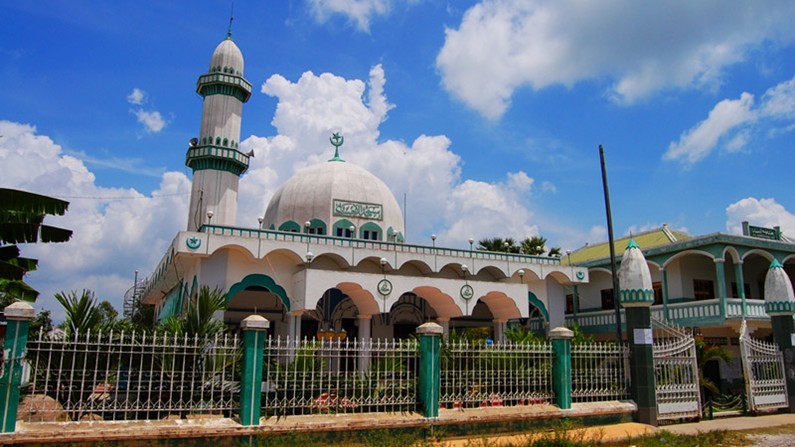
There is a quiet surprise waiting for Muslim travelers in Vietnam. Beyond the pho and the pagodas, in riverside villages of the Mekong Delta and along the south-central coast, communities have prayed toward the Kaaba for generations. They are the Cham — and their story is one of the oldest, most moving chapters of Islam in Southeast Asia.
For a visitor arriving during the Maulidur Rasul season, seeking out this heritage turns a holiday into something deeper: a reminder that the ummah reaches into corners of the world you’d never expect.
Who Are the Cham?
The Cham are an Austronesian people, descendants of the ancient Kingdom of Champa that flourished across central Vietnam for well over a thousand years. Long before the borders of modern Vietnam existed, Champa was a seafaring, trading civilisation — and it was through those maritime trade routes, linking the region to the wider Muslim world, that Islam first reached the Cham.
Faith arrived in layers. Hindu and Buddhist influences shaped Champa first; Islam took root more gradually, growing among the Cham over centuries. When the kingdom eventually fell and Vietnamese settlement pushed south, many Cham migrated — some to Cambodia and across maritime Southeast Asia, where they embraced Islam fully — before a number returned in the eighteenth century to settle in the Mekong Delta and the south. Those journeys are why, today, you’ll find Cham Muslim communities scattered from the coast to the delta to Ho Chi Minh City.
Two Expressions of One Faith
Part of what makes Cham Islam so fascinating is that it isn’t a single, uniform tradition. Broadly, there are two expressions — and understanding the difference helps you know what you’ll encounter where.
Cham Bani — the coastal tradition
In the south-central provinces of Ninh Thuan and Binh Thuan, the Cham Bani practise a deeply localised form of Islam, shaped by centuries of Cham culture. It has its own rhythms, its own clerics, and festivals such as Ramawan that you won’t find anywhere else in the world. It’s a living example of how a global faith adapts when it meets an ancient culture — beautiful, distinctive, and best approached with curiosity rather than comparison.
Cham Islam — the delta and the city
In An Giang, Tay Ninh, and Ho Chi Minh City, the Cham follow mainstream Sunni Islam, closely aligned with the practice familiar to Muslims across Malaysia, Indonesia, and the Arab world: five daily prayers, Friday jumu’ah, the fast of Ramadan, imams, and working mosques at the centre of village life. For most visiting Muslim travelers, this is the community you’ll feel immediately at home with.
Neither is “more” or “less” — they are two branches of the same deep-rooted heritage, and both are part of the story of Islam in Vietnam.
An Giang: The Heart of Cham Muslim Life
If you want to witness this heritage firsthand, the Mekong Delta province of An Giang — and the town of Chau Doc in particular — is where it comes alive. Just across the Hau River from Chau Doc lie the villages of Chau Giang and Chau Phong, home to some of Vietnam’s largest Cham Muslim communities.
These are not staged tourist villages. They are places where families live, weave, worship, and raise children much as they have for generations. You’ll see traditional wooden stilt houses raised above the seasonal floodwaters, women at handlooms weaving the brocade the region is known for, and — rising above it all — the domes and minarets of the community mosques.
The most celebrated is the Mubarak Mosque in Chau Phong, recognised as a national heritage site and instantly recognisable by its rounded roof tower crowned with the crescent and star. Nearby, the white-domed Masjid Al-Ehsan, built in 1937, sits serenely by the water. Both remain the beating heart of daily and religious life.
Here’s something that catches many Malaysian and Indonesian visitors off guard: the Cham of An Giang speak a language rooted in Malay. Strike up a conversation and you may find you understand one another more than you expected — a quiet, unexpected sense of kinship, half a world from home.
The photogenic high-water season (roughly August to November) is also when the surrounding floating villages and the Tra Su cajuput forest are at their most beautiful — a rewarding time to pair a heritage visit with the delta’s natural side.
Visiting with Respect
Because these are living communities of worship, a little courtesy goes a long way — and it’s warmly returned. Travelers consistently describe the Cham of Chau Doc as gracious and welcoming hosts.
- Dress modestly — as you would visiting any mosque. Loose, full-length clothing; women should cover their hair.
- Mind prayer times. Non-Muslim visitors are generally welcome to admire the courtyard and exterior but not to enter during prayers. Muslim travelers, of course, are welcome to join the congregation.
- Ask before photographing people — the architecture is fair game; individuals deserve a moment’s permission.
- Remember it’s a home, not an attraction. Move gently, keep your voice low near the mosque, and support local weavers or food stalls if you can.
Islam in the City: Ho Chi Minh City
You don’t have to reach the delta to touch this heritage. Ho Chi Minh City is home to a vibrant, international Muslim community — Cham alongside Malaysians, Indonesians, South Asians, and Arabs — and several of its mosques carry the Cham legacy directly. The best starting point is our complete guide to Saigon Central Mosque, the spiritual anchor for most travelers arriving in the city.
When to Visit
The Cham of An Giang observe the great markers of the Islamic year — the fast of Ramadan, the Eid celebrations, and the Prophet’s birthday among them — and these are the most atmospheric times to witness the community at its most alive. Layer that over the delta’s own seasons: November to April brings dry, sunny, comfortable weather, while August to November is the lush high-water season that makes the floating villages and forests sing. Whenever you come, a visit here rewards the traveler willing to look a little deeper.
At a Glance
- Region An Giang, Mekong Delta
- Base town Chau Doc
- Must-see Mubarak Mosque (national heritage)
- Community Cham Islam (Sunni)
- Getting there Ferry across the Hau River
- Best weather Nov–Apr (dry)
- Floating-village season Aug–Nov (high water)
- Etiquette Dress modestly · respect prayers
Final Thoughts
To stand in a riverside village in the Mekong Delta and hear the adhan drift over the water is to understand Vietnam differently. This is not a country where Islam is a recent arrival or a visitor’s convenience — it is a thread that has been part of the land for centuries, held with quiet devotion by a people whose kingdom is long gone but whose faith endures.
In the reflective spirit of Maulidur Rasul, there are few more meaningful journeys a Muslim traveler can make in Vietnam. Come with curiosity and humility, and the Cham community will show you a side of this country that most visitors never see.
Thinking of pairing this with a wider trip? See our Maulidur Rasul long-weekend guide for how to fit Vietnam into a few days — then subscribe for verified restaurant openings, mosque guides, and seasonal travel advisories delivered weekly.